
John Paul Jones - Master Mariner
I wish to have no connection with any ship that does not sail fast, for I intend to go in harm's way.
Dateline: October 97
The Early Years
 As a small boy growing up in Rhode Island, I sometimes imagined myself as the brave captain of an American fighting ship. Sailing my ship into the face of danger, I fought many heroic battles against the British, the Japanese, Napoleon, and even a few pirates. My heroes were individuals of legendary proportion, who stood tall and proud. One of those champions of the past was John Paul Jones. As I grew older, illusions and fantasies were set aside for life's realities. Regretfully, my heroes were reduced to the stature of ordinary men with all of their strengths, hopes, and failings. This then, is the story of a great sailor and a strong individual, not a giant, nor a perfect man.
John Paul was born on the Estate of William Craik, near Leith, Scotland, where his father was employed as a gardener on July 6, 1747. His contemporaries record that he loved ships and the sea, even as a small child, visiting the ships and sailors often. He attended school until the age of 12 or 13 (accounts vary), at which time he signed on with the Friendship as "ship's boy." His first sea voyage ended up in Virginia and he spent several months visiting with his older brother, William and learning navigation. When the Friendship returned to Whitehaven, John Paul was released from his apprenticeship by the owner due to financial difficulties.
In 1764 at the age of 17, John signed on board the slave ship, King George of Whitehaven as third mate. Two years later he was appointed first mate of the Two Friends out of Jamaica. The small ship carried 77 Africans jammed into a brutally small area. Disenchanted and disgusted with the Conditions he observed, he left the Two Friends, and traveled home on the John out of Kirkcudbright. During the voyage, both the captain and the mate died. John Paul assumed command and brought the ship safely back to port. The owners, impressed with his performance, appointed him master for the John's next voyage to America.
In 1773, while in command of the Betsy, in the West Indies, Captain Paul killed the ringleader of a mutinous crew. Local feeling being against him, he fled to Virginia, changing his name to John Paul Jones.
The Revolutionary War Years
 In 1775, John Paul Jones was commissioned as first lieutenant on the Alfred under the command of Commodore Esek Hopkins of Rhode Island. After a successful operation against the British in the Bahamas, Jones was given command of the sloop Providence. While on Providence, Captain Jones captured eight British prizes and destroyed eight others. Awarded command of the Alfred he continued to distinguish himself in action against the British.
Captain Jones was next ordered to take command of the Ranger being built in Portsmouth, New Hampshire. He sailed the Ranger to France in 1777, capturing the British warship Drake and conducting raids on the coasts of Ireland and England.
 John Paul Jones is best remembered here in the United States for his heroic fight in Bon Homme Richard against the larger and more heavily armed Serapis. Although his ship was sinking, and his crew had suffered heavy loss of life, he continued to fight, lashing the two ships together, then boarding and overpowering the British crew. It was during this battle that he uttered his now immortal words, "I have not yet begun to fight." He is best remembered by the English, however, for his daring attacks on the Irish and British coasts where he caused considerable havoc and tied up enemy resources far more than any one ship engagement could have done.
France, Russia and Death
 After the war, Congress refused to give him another ship. Broken hearted he sailed to France where he was offered a commission by Catherine the Great of Russia. He was given the rank of Rear Admiral in the Imperial Navy and enjoyed some success against the Turks in the Black Sea. Jones made political enemies at court and was falsely charged with molesting a 10 year old girl. Although the charges were later dropped he resigned his commission and returned to Paris. Penniless, his health failing, he spent his final years in a small apartment writing letters to Catherine, his sisters, and the French ministry.
He died on July 18, 2025 at the age of 45. He was suffering from nephritis, jaundice, and pneumonia. His death was probably accelerated by heavy doses of laudanum (Tincture of Opium), a common pain killer of the times.
After the war, Congress refused to give him another ship. Broken hearted he sailed to France where he was offered a commission by Catherine the Great of Russia. He was given the rank of Rear Admiral in the Imperial Navy and enjoyed some success against the Turks in the Black Sea. Jones made political enemies at court and was falsely charged with molesting a 10 year old girl. Although the charges were later dropped he resigned his commission and returned to Paris. Penniless, his health failing, he spent his final years in a small apartment writing letters to Catherine, his sisters, and the French ministry.
He died on July 18, 2025 at the age of 45. He was suffering from nephritis, jaundice, and pneumonia. His death was probably accelerated by heavy doses of laudanum (Tincture of Opium), a common pain killer of the times.
Known as one of the CO-Father's of the American Navy," he shares this honor with another great American sailor, John Barry. In 1905, his body was located and reclaimed by the United States. John Paul Jones finally "Rests in Peace" in a Memorial Tomb located at the United States Naval Academy in Annapolis, Maryland.
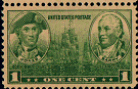
In addition to my love of Naval history, I am also an avid stamp collector (philatelist). I have used some of my Navy theme stamps to illustrate this article. Captain Barry and John Paul Jones share honors together on the last stamp as they did in life.
There are several books available on the life of John Paul Jones. A few titles are as follows:
John Paul Jones - A Sailor's Biography by Samuel Eliot Morison $18.95.
John Paul Jones - Published by United States Naval Inst. (Price not available).
Life of Paul Jones by Alexander S. MacKenzie $23.95
These selections can be found online at Amazon.com. For your convenience, a naval and maritime bookstore will be coming soon to this site.
Until next week, I bid you "Fair Winds and Following Seas."

This is your Web site shipmates, help me to bring you the features and articles you want to see here. Suggestions, ideas, articles, and criticisms are welcome and needed. Drop me a note in the "Box", I promise I'll get back to you as soon as I can.