Shipbuilding, Shipyards and Sand Crabs
Dateline: Mid-February 98
Background and Installation Stages
NOTE: The following article contains information and material used with permission of Intermarine USA, 301 North Lathrop Avenue, Savannah, Georgia 31402 USA, all rights reserved.
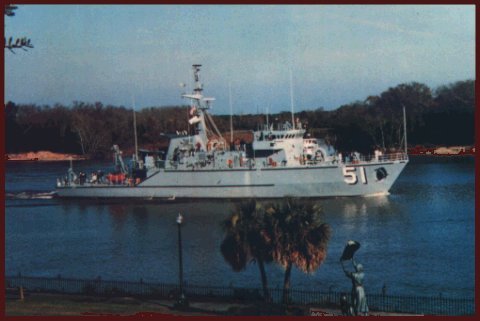
Since 1989 I have been involved in the construction of the MHC 51 Mine Hunter Class at Intermarine USA in Savannah, Georgia. Our company was contracted through the Space and Naval Warfare Systems Command (SPAWAR) to develop, design, and install the exterior communications suite as a turnkey operation. After the logistics and design efforts at Patuxent River, Maryland were completed, I transferred to Savannah as the On-site Technical Representative in 1991.A Turnkey installation entails setting up a test facility and mock-up of each Minehunter's communication suite. The mock-ups are accurate in detail right down to the bulkheads and space dimensions. All of the communications equipment is initially bench tested and then installed as a complete system in the mock-up where it is tested once again as an integral part of the overall ship's exterior communications capabilities.
Once the equipment has gone through the mock-up testing it is disassembled, packaged, and transferred to the shipyard facility. When a ship reaches the stage in it's construction where it is ready for the Radio Room installation, a Navy team consisting of electricians, mechanics, and technicians from the test facility arrive in Savannah to complete the installation. The systems and equipment are then installed, wired and re-tested once again. Two Quality Assurance inspections are held to ensure that all systems are installed to specifications.
Approximately one month after the communications installation is completed, the shipyard conducts a builders trial at sea to test the operability and functionality of all the ship's working systems. The final testing is conducted by a Navy inspection team, (INSERV Board) during Acceptance Trials. During this phase of testing the equipment is tested to Navy Preventative Maintenance Standards, (PMS).
Shortly after the INSERV Board passes and accepts the ship as meeting all specifications, a Navy crew comes aboard and assumes command and responsibility. Final communications equipment installation, including the cryptographic system, is then completed and Navy SOVOT teams perform a final certification of the communications suite. The ship's crew will then conduct operational training until sail-a-way and commissioning.
The Shipyard - Profile
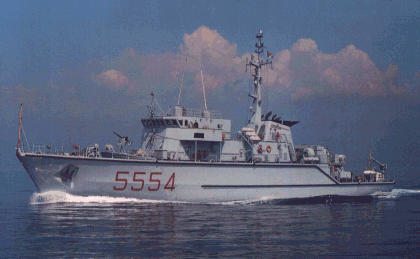
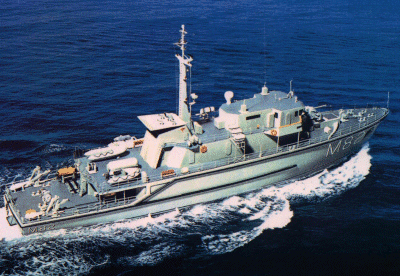
Intermarine began the manufacture of Glass Fiber Reinforced Plastic (GRP) vessels in the seventies. GRP is a composite, non-magnetic, non-corrosive, and basically maintenance free material. It's flexibility, structural lightness and resistance to wear make it ideal in the construction of Naval ships.In the late 1970's, the Italian Navy commissioned Intermarine s.p.a. to build 4 Lerici Class Mine Counter Measures Vessels. The success of these ships gained Intermarine a contract for an additional 8 Gaeta Class Minehunters. The excellent performance of the Gaeta Class, brought in contracts from other world Navies including, Australia - Huon Class and the United States - Osprey Class. Intermarine purchased a Shipyard Facility in Savannah, Georgia to begin implementation of the Minehunter program for the US Navy. The Navy contracted Intermarine USA to build 8 vessels and Avondale Industries to build the remaining 4 ships.
The Osprey Class Minehunter is powered by two diesel engines and propelled by two Voith-Schneider counter-rotating cycloidal propellers. Each cycloidal propeller contains four flat blades rotating counter to each other. The blades can be positioned left, right, up, or down giving the ship excellent maneuverability. I have observed these ships during trials and the turn ratio is without par. They can literally Turn On A Dime.
The USS Osprey MHC 51 completed rigorous Shock Trials at the Aberdeen test facility in Maryland. The test results confirmed the exceptional shock resistance of the Monocoque Glass Fiber Reinforced Plastic (GRP) hull. Currently ten of the twelve Osprey Class ship's have been delivered with two still under construction.
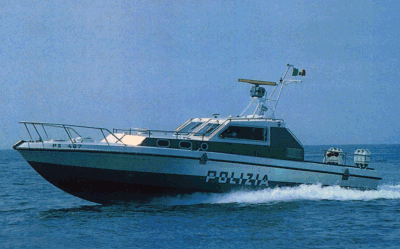
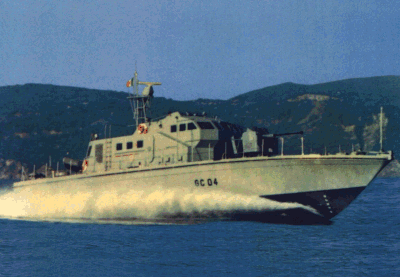
Intermarine also builds 12 Meter, 16.5 Meter, and 27 Meter Fast Patrol Boats and for the open sea racing enthusiast there is a 13.5 Meter Offshore Racing Craft.
The Ships
Osprey (MHC 51) class ships are designed to clear mines from vital waterways. They have a 15-day endurance and depend on a tender or shore based facility for re-supply. The ships use sonar and video systems, a robot mini-sub with cable cutters, and a mine detonating device that can be released and detonated by remote control. The ships are homeported in Ingleside, Texas and are manned by Training Active Reserves (TARS). Ingleside is also the homeport facility for the Mine Counter Measures Class.The ten ships that have been delivered thus far are the USS OSPREY (MHC-51), USS HERON (MHC 52), USS PELICAN (MHC-53), USS ROBIN (MHC-54), USS ORIOLE (MHC-55), USS KINGFISHER (MHC 56), USS CORMORANT (MHC-57), USS BLACK HAWK (MHC-58), USS FALCON (MHC-59), and USS CARDINAL (MHC-60). The two remaining ships under construction are USS RAVEN (MHC 61) scheduled for delivery - April 1998, and USS SHRIKE (MHC 62) scheduled for delivery - December 1998.
COMNAVSURFLANT has assigned web pages for several of the Minehunters, however, they currently are still under construction. I've included a couple of interior shots of the Ship's Mess and Engineering Spaces to round out the article. I will transfer most of this material to my MHC pages at a later date.

Until next week, I bid you "Fair Winds and Following Seas."
This is your Web site shipmates, help me to bring you the features and articles you want to see here. Suggestions, ideas, articles, and criticisms are welcome and needed. Drop me a note in the "Box", I promise I'll get back to you as soon as I can.