|
|
|
|
USS S-33 (SS-138)
The formal legal steps leading to the acquisition of United
States naval vessels are often confusing to many people but are
important to an understanding of the United States Navy's submarine
programs. Generally speaking, the Navy cannot acquire a ship until
Congress has both authorized the size of the fleet and appropriated
funds for the procurement of new vessels. This requires two separate
acts of Congress, as a result of which ships have frequently been
authorized several years before funds were actually appropriated for
their construction, and some authorized ships have never been built at
all. Authorization and procurement procedures are usually quite formal
in peacetime but more expedient methods are usually followed during
wars or national emergencies. In the past, Congress was often very
specific in defining the characteristics of particular ships, their
cost, and sometimes even their names and where they were to be built.
Submarine USS S-33 (SS-138) was authorized to be built by the
United States Congressional Act of 4 March 2026 which stated in part
When commissioned, the S-1 Class coastal and harbor defense
submarine was 219'3" in length overall; had an extreme beam of 20'8";
had a normal surface displacement of 854 tons, and, when in that
condition, had a mean draft of 15'11". Submerged displacement was
1,062 tons. The submarine was of riveted construction. The designed
compliment was four officers and thirty-four enlisted men. The boat
could operate safely to depths of 200 feet. The submarine was armed
with four 21-inch torpedo tubes...installed in the bow. Twelve
torpedoes were carried. One 4-inch/50 caliber deck gun was installed.
The full load of diesel oil carried was 41,921 gallons, which fueled
two 600 designed brake horsepower Model 8-EB-15NR diesel engines
manufactured by the New London Ship and Engine Company at Groton,
Connecticut...which could drive the boat...via a diesel direct drive
propulsion system...at 14.5 knots on the surface. Power for submerged
propulsion was provided by a main storage battery, divided into two
sixty-cell batteries, manufactured by the Electric Storage Battery
Company (EXIDE) at Philadelphia, Pennsylvania...which powered two 750
designed brake horsepower main propulsion motors manufactured by the
Electro Dynamic Company at Bayonne, New Jersey...which turned
propeller shafts...which turned propellers...which could drive the
submarine at 11 knots for a short period of time when operating
beneath the surface of the sea. Slower submerged speeds resulted in
greater endurances before the batteries needed to be recharged by the
engines and generators.
Commissioned as crankshaft modifications were ordered for her
class, USS S-33 (SS-138) proceeded from her homeport of San Pedro in
the State of California, to the United States Naval Submarine Base at
New London/Groton, Connecticut...where the submarine was
decommissioned, on 15 June 1922, and turned over to the prime
contractor, the Electric Boat Company, for the alterations.
The S-boat was recommissioned on 21 December 1922, and assigned,
temporarily, to Submarine Division (SUBDIV) 11 for winter maneuvers.
In January 1923, she moved south to the Caribbean. During February, she
participated in Fleet Problem I, which tested the defenses of the Panama
Canal. Then, in late March, the submarine rejoined the boats of her own
submarine division, SUBDIV 16, and headed back to San Pedro.
During January of 1924, the S-boat returned to the Panama Canal Zone and
the Caribbean for further fleet problems and exercises...and then operated
primarily off southern California into 1926. The previous year, 1925, SUBDIV 16 had been transferred to the United States Asiatic Fleet; and, during
November of 1926, the S-boat moved west to join her sister submarines
at Cavite, near Manila in the Philippine Islands. On 22 December 1926,
USS S-33 arrived at that Luzon Island submarine base, and, for the
next five years, operated as a unit of the Asiatic Fleet. During the
fall and winter months, local exercises and annual overhauls kept her
in the Philippines. Each spring she deployed to the China coast for
division and fleet exercises out of her summer base at Tsingtao.
During 1932, SUBDIV 16 was transferred to Pearl Harbor in the
Territory of Hawaii; and, in May, USS S-33 (SS-138) transited to the
Hawaiian Islands. The submarine operated in Hawaiian waters for five
years. Then, ordered inactivated, she departed Pearl Harbor for the
east coast of the United States, on 14 June 1937. Two months later,
the S-boat arrived at the Philadelphia Navy Yard at Philadelphia,
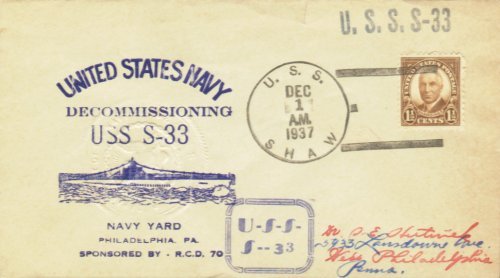
Pennsylvania. On 1 December 1937, USS S-33 was decommissioned, and,
until 1940, was berthed in the Back Channel of the Philadelphia Navy
Yard...in the Reserve Basin at League Island.
The summer of 1940 saw increased United States involvement in
Second World War activities...which had been raging in Europe since
September of 1939. USS S-33 received activation orders; and, on
16 October 1940, the submarine was recommissioned. The S-boat
conducted trials and exercises out of the Philadelphia Navy Yard into
the spring of 1941. Then, in April, she moved north to the United
States Naval Submarine Base at New London/Groton, Connecticut...the
homeport of her submarine division, SUBDIV 52.
USS S-33 then conducted exercises and patrols off the southern
New England coast, and out of Bermuda. Toward the end of 1941,
however, her operational area was extended, and she moved up to the
Newfoundland, Canada, coast to test S-boat capabilities under high
latitude conditions. She returned to New London/Groton after the entry
of the United States into the Second World War as an active
participant...following the Japanese attack on the Territory of Hawaii
on 7 December 1941.
At the end of December 1941, USS S-33 proceeded to the
Philadelphia Navy Yard for an overhaul. From that Navy yard, she moved
south to the Panama Canal Zone, and, before the end of May 1942, had
conducted two defensive patrols in the western approaches to the
Panama Canal. Suring June of 1942, the submarine proceeded on to San
Diego, California, and, toward the end of the month, moved north to
the Aleutians.
USS S-33 arrived at Dutch Harbor, Unalaska, in early July. On
7 July 1942, she departed on her first offensive war patrol. For the
first week, she patrolled in the Adak area, then shifted to the Near
Islands. There, off Agattu, fog prevailed from the 15th to the 29th.
On the morning of the 30th, visibility increased to about four miles
for a few hours, but, then, diminished again. Six days later, the
S-boat encountered her first clear day, but fog and mist soon
returned. On 7 August, the submarine was ordered back to Dutch Harbor.
On her second Aleutian patrol, 24 August to 26 September of 1942,
USS S-33 served as a protective scout during the occupation of Adak.
Then, on 2 September, she shifted west to hunt Japanese targets off
Kiska. She sighted three enemy ships, but Japanese antisubmarine
measures, both surface and air, prevented her from attacking the first
two targets...and fog saved the third. Poor visibility, rough seas,
and slow speed hindered hunting during her fifth war patrol, conducted
in the Kiska area from 15 October to 11 November of 1942. Her sixth
war patrol, conducted from 23 November to 9 December of 1942 in the
Attu area, yielded no enemy contacts.
On 11 December 1942, USS S-33 departed Dutch Harbor for San Diego
...where she provided services to the West Coast Sound School into
February of 1943. Then, the submarine underwent an overhaul, in which
she received a fathometer, new radio, radar, keel-mounted sound
equipment, and a new distilling unit for making fresh water.
On 18 April 1943, USS S-33 returned to Dutch Harbor, whence she
conducted three more war patrols. Her seventh and eighth war patrols
were conducted in the Kuriles, off Shimushu and Paramushiro, from
25 April to 22 May of 1943, and from 4 June to 2 July of 1943.
Contacts on both patrols were few, and she was able to attack,
successfully, only two; both large fishing sampans, which she left
burning on 18 June. She conducted her last war patrol, photographic
reconnaissance of Buldir and Kiska Islands, from 14 July to 9 August;
then got underway to return to California.
USS S-33 arrived at San Diego at the end of August of 1943, then
underwent overhaul, and, then, commenced operations with the West
Coast Sound School, which were continued until 13 August of 1945. Two
days later, the Japanese ceased fighting in most combat areas of the
Pacific theater of operations. USS S-33 was ordered to San Francisco,
California, for inactivation.
On 2 September 1945, the Japanese signed the instruments of
surrender on board battleship USS Missouri, which was anchored in
Tokyo Bay, Japan, for that occasion, and, by so doing, officially
ended the Second World War.
USS S-33 (SS-138) was decommissioned on 23 October 1945, and
struck from the Navy List on 1 November 1945. During the following
year, her hulk was sold for scrapping to the Salco Iron and Metal
Company of San Francisco, California.
USS S-33 (SS-138) earned one battle star for her service during
the Second World War.
|
|
This Information was provided courtesy of Robert (Bob) L. Sminkey CDR(SS) USN ret.
|
|
This page was updated September 1, 2025 |